Your security team just got a lot bigger
Leen agents connect your security tools, normalize the data, and run end-to-end campaigns - from finding the problem to proving it's fixed.
Security teams shouldn’t spend their days copying data between tools
Fifteen tools. Five scanners. Every investigation is the same ritual: open a finding, pivot to the asset inventory, check the owner in Okta, look up business context, figure out who gets the ticket. Meanwhile, the backlog grows, SLAs slip, and auditors want evidence you have to compile by hand.
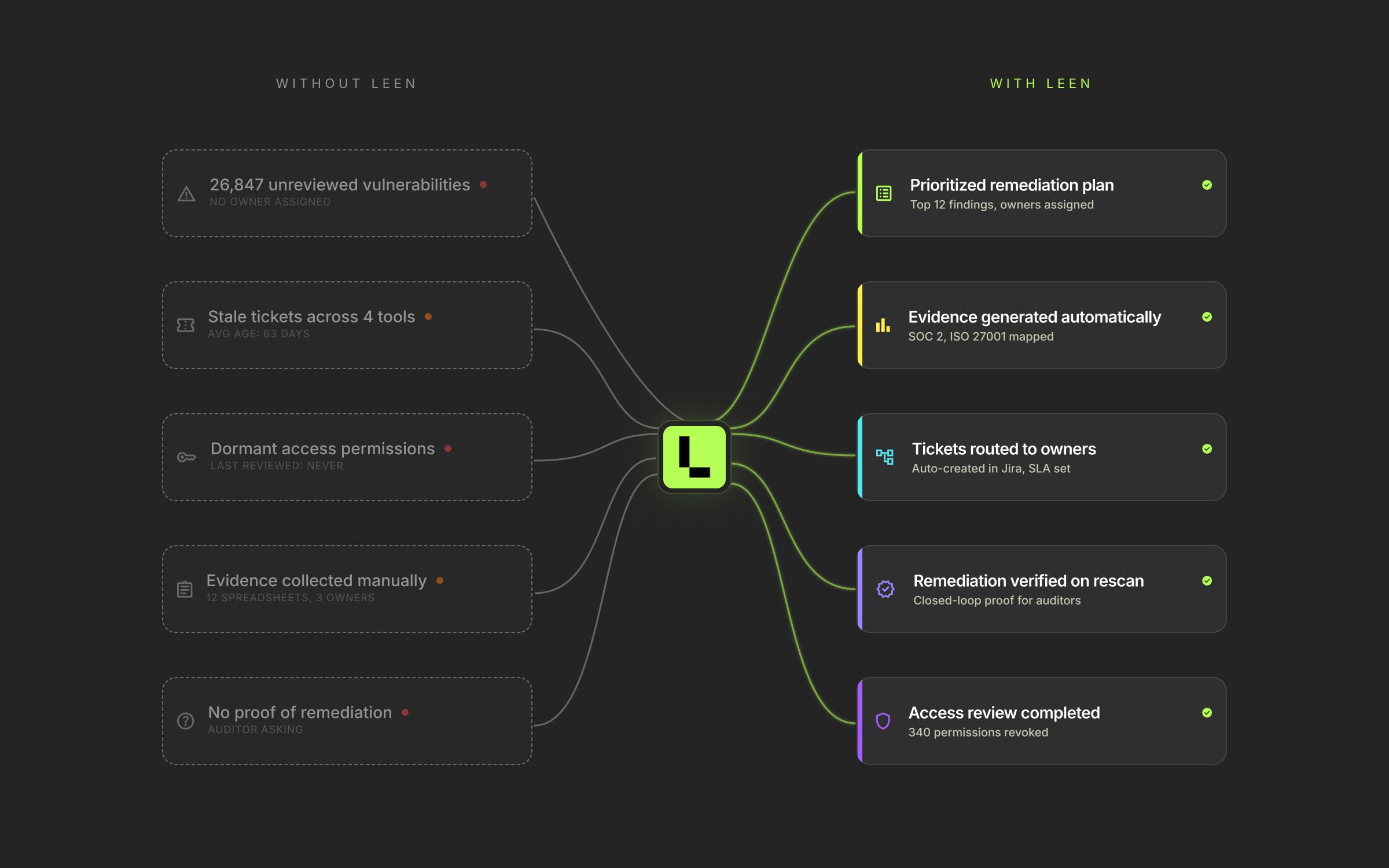
Without Leen
Findings in one tool.
Assets in another.
Ownership in a spreadsheet.
Your team spends days stitching data together before any remediation even starts.
Assets in another.
Ownership in a spreadsheet.
Your team spends days stitching data together before any remediation even starts.
With Leen
One conversation: "Run our quarterly cloud posture campaign."
Leen normalizes the data, enriches findings with business context, routes to owners, follows up, and proves completion.
Leen normalizes the data, enriches findings with business context, routes to owners, follows up, and proves completion.
What if your tools could actually work together?
Leen connects your security and business applications, builds a unified picture of your environment, and gives your team an AI collaborator that does real work, not just generates dashboards.Step 1
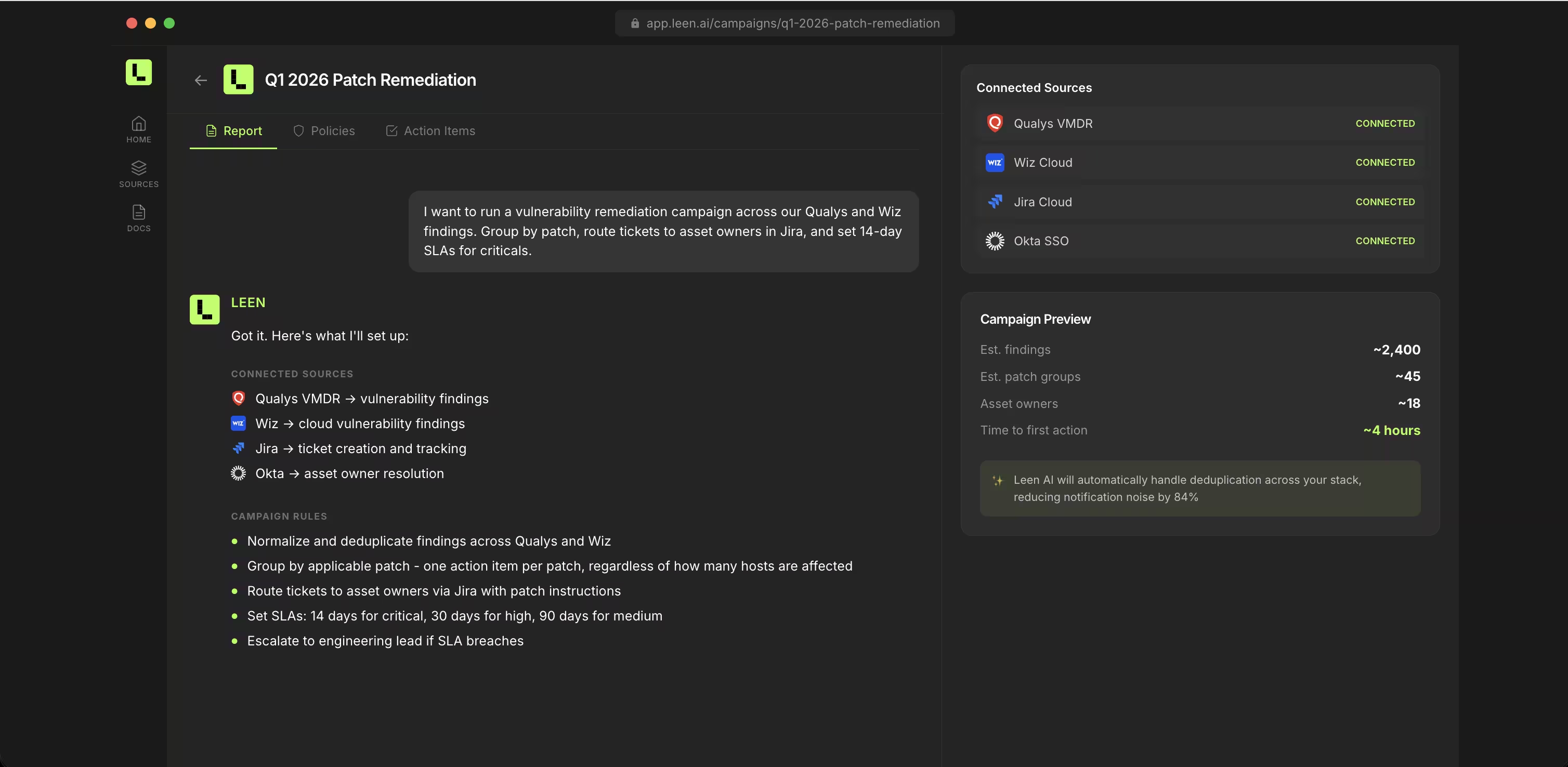
Tell Leen what you’re working on
Vulnerability management, access reviews, or audit prep. Define your security objective and Leen connects to the relevant tools to make it happen.
Step 2
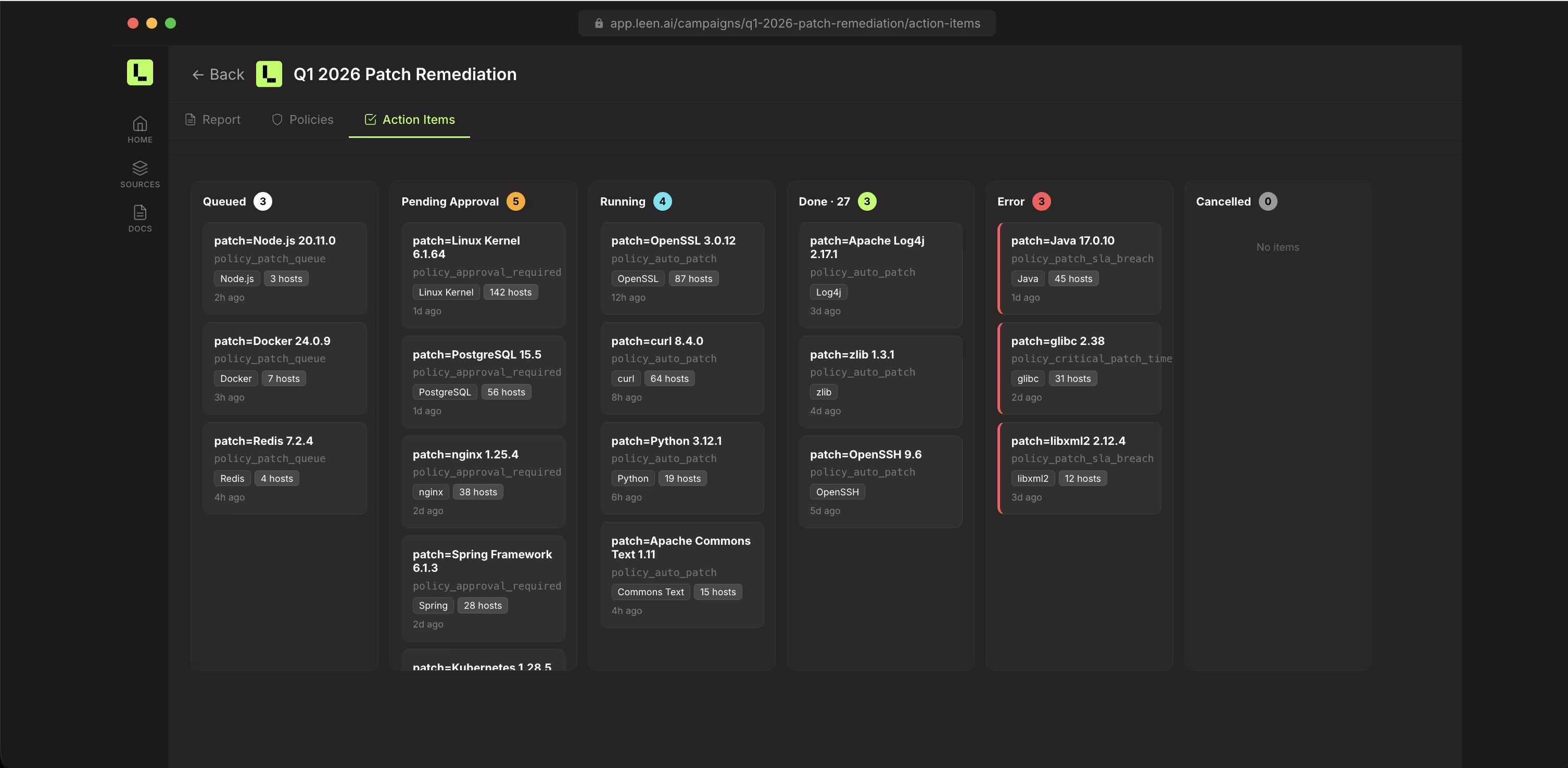
Leen investigates and builds a plan
Cross-references your scanners, identity providers, cloud platforms, and ITSM tools. Presents a prioritized action plan.
Step 3
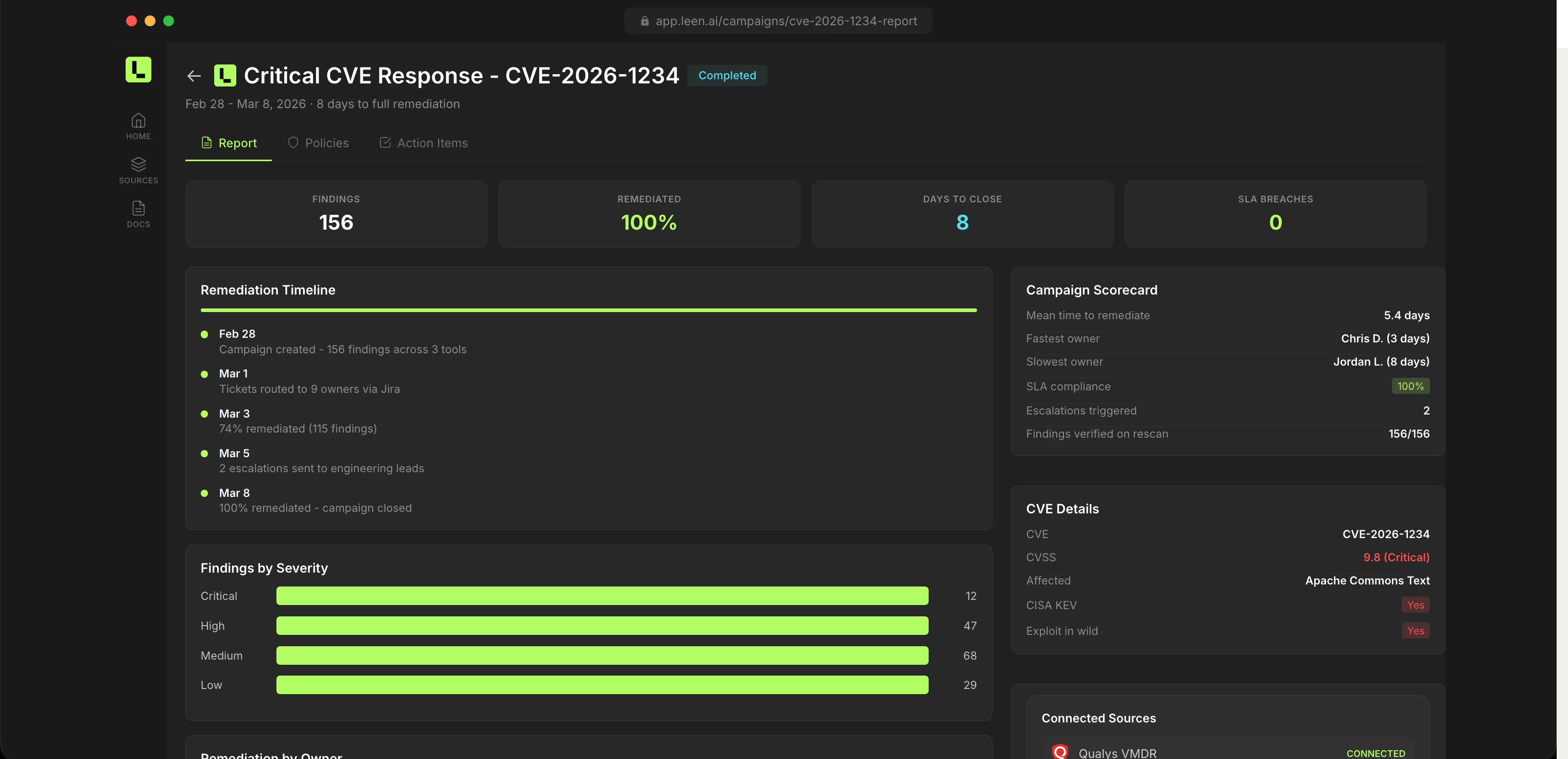
Approve it and move on
Leen creates tickets, follows up with owners, escalates overdue items, and validates fixes- all without pulling your team out of Slack. Security engineers manage programs, check status, and adjust policies right from the tools they already use. Asset owners and engineers get pinged in Slack with exactly what they need to do.
Use cases
One platform across your security programs
One agentic platform that works across your programs

What changes with Leen
4
0
9
4
3
7
8
6
4
1
5
4
3
2
7
8
0
4
2
0
+
From spreadsheet to system
Remediation tracked end-to-end. Every finding, every owner, every SLA in one place instead of scattered across Jira, Slack, and Google Sheets.
4
0
9
4
3
7
8
6
4
1
5
4
3
2
7
8
0
4
2
0
+
From finding to fix
Leen doesn't stop at detection or prioritization. Findings get routed, followed up, validated, and closed without your team chasing tickets.
4
0
9
4
3
7
8
6
4
9
8
4
3
2
7
8
0
4
2
0
%
From quarterly scramble to continuous proof
Evidence generated as a byproduct of real remediation. Always audit-ready, not assembling screenshots the week before.










.svg)
.svg)
.svg)
.svg)
.svg)
.svg)
.svg)
.svg)
.svg)
.svg)
Frequently asked questions
What is Leen?

An agentic security engineering platform. Leen connects to your tools, understands your environment, and helps your team investigate, prioritize, and remediate with AI that takes action, not just generates reports.
How is Leen different from a SIEM or SOAR?
SIEMs aggregate logs. SOARs run predefined playbooks. Leen builds a context graph across your tools, reasons like a senior engineer, and executes multi-step workflows with your approval. It’s a collaborator, not a pipeline.
Does Leen replace my existing security tools?
Leen connects to what you already have and makes it work together. Our agent can also help you reduce tool costs by identifying overlapping or redundant coverage.
What does ‘human-in-the-loop’ mean?
Leen shows you exactly what it plans to do before executing. Approve, modify, or reject any action. Set auto-approval policies for routine tasks. You’re always in control.
How long does it take to get started?
Most teams connect their first tools and see value within a day. No custom development, no months-long deployment.
What does Leen access?
Leen connects via read-only API access to your existing tools. It normalizes findings, assets, identities, coverage data, policies, and workflows into a unified data layer. Your data stays in your environment. Leen never stores raw credentials or sensitive PII.
Can Leen take actions, or does it just recommend?
Both. Leen executes approved actions like creating Jira tickets, sending Slack notifications, and updating tool configurations. You set the approval policies: auto-approve routine actions, require human sign-off for sensitive ones. You’re always in control of what Leen can do.


Support

©2026 All Rights Reserved. Leen, Inc.